The model of a contrivance by means of which could certainly get possession of the sheets which were to be a rope; it was a short stick attached by one end to a long piece of thread. By this stick intended to attach the rope to the bed, and as the thread hung down to the floor of the room below, there should pull the thread and the rope would fall down. Tried it, and congratulated the invention, as this was a necessary part of scheme, as otherwise the rope hanging down would have immediately discovered me.
I pull the thread, unravelling round this tiny labyrinthine, a room for music and dance.
Sitting, sets the thread. Set of dining-room furniture constructing a whole geography of consciousness proceeding along inescapable pastimes merely accursed.
Empty dress stretched over their shoes plays in the background. Bleached dust expectations of necessity, haunted expression, a voice is singing. Lyricism to a reality both silent and unexampled. Time edge limits of wants irrational.
A small bead is tied to the thread on the outside of the bag. The purpose of the bead is to have something which may be seen and easily grasped so that the cork can be released without fumbling. In case the bag is of a material or design which would make the bead noticeable, there are two alternatives. One is to sew a number of beads onto the bag where such added decoration would be in keeping. The other is to run the thread through the material to the outside of the bag and, at a point about a half an inch distant, run the thread back through the bag and fasten it to the inner surface of the bag. This will make a loop of thread flat against the outside surface of the bag which, by slipping a fingernail under the loop, makes it simple to pull the thread and thereby remove the cork. The thread used must be extra strong to avoid any chance of having it break. Linen thread is suitable. When thread of a matching color is used, it is invisible, and even a contrasting color is not apt to be noticed and, when noticed, is meaningless.
An open pair of scissors down its throat along a single word of refined manners, circumstances naked and shivering, tiny moment among inscribed photos blurred and damaged. Symmetrical nothing of continual resemblance, vaguely waiting to remember the girls were pretty at the seaside, beneath black sky senses its wide sweep along boundaries of the body reaching. Thread touched unfolds.
This is not who I remember. The first body was an environment a land-mark on the frontier of tomorrow. In the meaning of the day the way one turns and looks—eyes for hands. Today the stranger the exile and spook are in my shaving mirror. In my dream you are real. I am as one who each day stands behind the tapestry and receives the needle to pull the thread taut and pass it back through. The design is no one’s.
This may just be an illusion, high heels flimsy brightly colored dresses tucking her blouse sprinkled with icing sugar, imagine deep sleeps in the afternoons peering through a keyhole, with a little culture, yards of fabric and not much trouble, getting dressed up for existence between belief and unbelief. Elevator door trundles shut.
OE Ælfric Catholic Homilies: 2nd Ser. (Cambr. Gg.3.28) xx. 194 Hit is awriten be ðam yfelum timan. OE Anglo-Saxon Chron. (Laud) (Peterborough interpolation) anno 654 On his time þa comon togadere heo & Oswiu Oswaldes broðor cyningas. OE Laws of Edgar (Nero E.i) iv. ii. 208 Mine þegnas hæbben heora scipe on minum timan, swa hy hæfdon on mines fæder. OE tr. Defensor Liber Scintillarum (1969) ix. 96 Multi enim se credebant longo tempore uiuere : soðlice hi gelyfdon lange timan lybban. OE Wulfstan Last Days (Hatton) 134 Wa ðam wifum þe þonne tymað & on þam earmlican timan heora cild fedað. 1160 Anglo-Saxon Chron. (Laud) (Peterborough contin.) anno 1137 Nu we willen sægen sumdel wat belamp on Stephnes kinges time.
To describe it, À la recherche du temps perdu is an album I released in two thousand twenty one. Six lp records, twelve sides each about twenty minutes.
Total run time two hundred forty one minutes. The album is based around the novels by Proust, Valentin Louis Georges Eugène Marcel Proust, and is predicated on a few threads … The music of the novels, the music Proust (an avid music collector) had in his head and in his collection, the anthems of the Faubourg Saint-Germain. What music one might hear getting lost in Paris of the Belle Époque? The content includes twenty six composers and a Dixieland jazz band: Bartók, Bellini, Berg, Brahms, Caccini, Chausson, Chopin, Debussy, Delibes, Donizetti, Franck, Hahn, Jungmann, Louisiana Five, Lully, Ravel, Saint-Saëns, Satie, Schoenberg, Schubert, Schumann, Scriabin, Strauss, Tchaikovsky, Verdi, Wagner and Weber.
The primary impetus for the album came from my truck.
When I think about Harold Budd several different thoughts and images come to mind, one is an old alternate definition of ‘wine’ … Old English wine = Old Frisian winne, Middle Low German wine, Old Saxon, Old High German wini (Middle High German wine, win), Old Norse vinr. … a friend.
OE Beowulf 30 Þenden wordum weold wine Scyldinga. 1122 Anglo-Saxon Chron. (Laud) ann. 975 Eadgar..West-Seaxena wine. 1200 Moral Ode (Trin. Coll. MS.) 223 Werse he doð his gode wines þan his fiendes. 1220 Bestiary 374 Eurilc luuen oðer, Also he were his broder, Wurðen stedefast his wine. 1481 W. Caxton tr. Hist. Reynard Fox (1970) 70 He hath nether kyn ne wyn ne frende that wylle entreprise to helpe hym.
I was introduced to Harold by David Sylvian. David had sent me a letter (handwritten, charming), an invitation to release an album on Samadhisound. While we were working on it, he ask me to make a coda for Avalon Sutra as album was running short … the source recordings arrived as a box of blackface ADAT tapes. I took little bits here and there into a very slowly unwinding ostinato. The intention was for it to be ten or so minutes, but I wanted David to get his hand in so I made a seventy minute version and told David to cut it where and how he wanted … he used the whole long track as a second disc.
圈 Describing a Circle; 1305 Edmund Conf. 232 in Early Eng. Poems & Lives Saints (1862) 77 Þreo rounde cerclen heo wrot: in þe paume amidde., concentric; 1400 G. Chaucer Treat. Astrolabe (Cambr. Dd.3.53) (1872) i. §17. 10 The heued of capricorne turnyth euermo consentryk vp-on the same cercle.
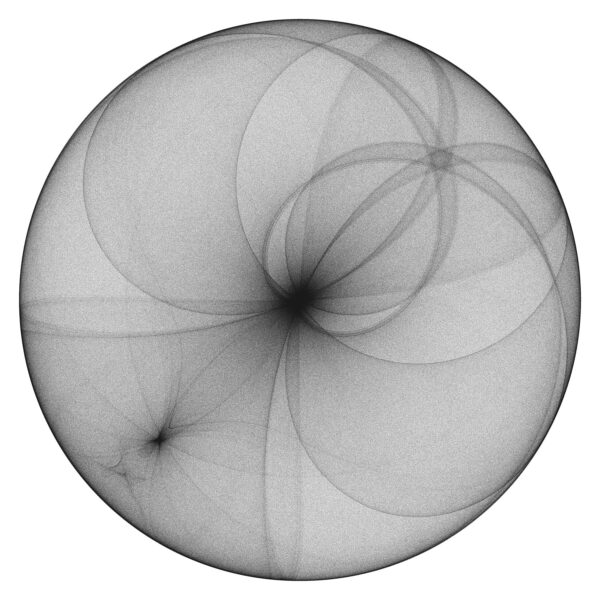
x = sin( -5.009757041932 * y ) – cos( 5.0073237419122 * x ); y = sin( -5.006352424622 * x ) – cos( 5.0065770149236 * y );
Angular rotation, position, calculated across four billion seven hundred twelve million three hundred eighty eight thousand nine hundred seventy five iterations; graphite touching arc to shade on paper, through Faber-Castell pencil I am a circle inscribed. I am a little cowboy in South Texas, shooting metal plates hanging on a barbed wire fence. Shot striking metal to chime, dreaming sound of bell, 1225 Ancrene Riwle (Cleo. C.vi) Þet ower beoden bemen wel & dreamen in drichtines earen. Time occupied by the same nature in mind, symbolism or a thing, a radiance of observation, synthesis succeed one and makes them of the soul, a dark room also occupied by dreaming itself. Aristotle describes the primary being as an intellect or a kind of intellect that “thinks itself” perpetually. A primary substance must be what is both ontologically and epistemically basic, i.e., that which the existence of everything else depends, and on which our systematic knowledge depends. Circles in circles carved in stones as Mayan haab and tzolkin, civil and divine, against the long count of distant memory, days to come curving into a distant past. Stairless cylinder of words overheard in the woods at night among the same stone altars in grey watercolor shades, circles bent towards straight lines, appetite and practical thought, affections and actions of knowledge. The eye being merely the matter of seeing, sense is either a faculty or a separation by the same act dividing the time, obscure to obscurity… learning how to fall in love with my mistakes. Time occupied by the same nature in mind, symbolism or a thing, a radiance of observation, synthesis succeed one and makes them of the soul, a dark room also occupied by dreaming itself. The eye is the first circle; the horizon which it forms is the second; and throughout nature this primary picture is repeated without end. It is the highest emblem in the cipher of the world. St. Augustine described the nature of God as a circle whose centre was everywhere and its circumference nowhere. Here we are bound by many circles.
In the ’60s and early ’70s, when you, along with a few other people, were inventing conceptual art, what did you think you were doing? What did you think it’s future would be … ?
1384 Bible (Wycliffite, E.V.) (Douce 369(2)) (1850) Dan. ii. 5 Bot ȝe shuln shewe to me the sweuen, and the coniecturyng, or menyng, therof. 1400 Mandeville’s Trav. (Roxb.) viii. 29 By þe chaungeyng of þe coloures men..knawes and coniectures wheder it schall be derthe of corne. 1440 Promptorium Parvulorum 464/1 Solvyn, supra in onbyyndyn. 1450 Alphabet of Tales (1904) I. 254 And on þis maner þai war wunt..for to solve þer faste. 1450 J. Lydgate Secrees 1259 Afftir the sesouns Solve flewm brennyng or moysture. 1460 Promptorium Parvulorum (Winch.) 322 Onbyyndyn, or solvyn, soluo.
1513 R. Fabyan New Cronycles Eng. & Fraunce (1516) I. clxxxvi. f. cx Whiche thynge thus by the kynge desyred, the Lordes anone coniectured in their myndes that he desyred the kepynge of theyr yonge lorde, to ye ende that he myght the more easyerly optayne the possession of that Dukedome. 1528 S. Gardiner in N. Pocock Rec. Reformation (1870) I. l. 104 To the intent we might the better discipher the very lett and sticking. 1529 Bp. S. Gardiner Let. 7 Sept. (1933) 39 Bicause they [sc. letters from Rome] be moch in cifre, his Hignes desireth your Grace that they may be disciphred there and remitted hither again. 1529 T. More Supplyc. Soulys ii. f. xxxviv Yf he wold now..beleue those .iii. or .iiii. noughty persons, agaynst those .iii. or .iiii. C. good and honest men: he then shuld well decypher hym self, and well declare therby, [etc.]. 1530 J. Palsgrave Lesclarcissement 494/1 As I conjecture, it wyll be founde. 1550 J. Bale Image Both Churches (new ed.) ii. sig. h.iijv Wythout the blynd bussynges of a papyste, may no synne be solued. 1551 R. Robinson tr. T. More Vtopia sig. Nii They furthwyth verye wyttelye coniectured the thynge [sc. paper-making]. 1552 R. Ascham Let. July in H. Ellis Orig. Lett. Eminent Literary Men (1843) 12 Your Mrship is wel ware in seeing our lettres fittly dissiphered, lest..a clear other mynd may appeare in reading, than was ment in writing. 1555 R. Eden tr. Peter Martyr of Angleria Decades of Newe Worlde i. vi. f. 30v They coniectured that these thynges portended sum great matter. 1567 G. Fenton tr. M. Bandello Certaine Tragicall Disc. f. 253v He not liking to..heare the secrettes of his falte so plainely decipherede, replied accordynge to the discrecion of our wilfull youth now adaies. 1569 E. Fenton tr. P. Boaistuau Certaine Secrete Wonders Nature xli. f. 139v Ther was found sundry learned and holy men, which began not only to decipher the misery of this infant [Fr. a philosopher sur la misere de cest enfant], but also ye monstrous shape therof in this sort, saying, yt by the horne was signified pride & ambition, by the wings lightnesse & inconstancie. 1572 J. Knox Hist. Reformation Scotl. in Wks. (1846) I. 191 Thane begane he to dissipher the lyves of diverse Papes, and the lyves of all the scheavelynges for the most parte. 1573 G. Harvey Let.-bk. (1884) 40 Being not able to coniecture what purpose he should have in his hed. 1574 J. Dee Let. 3 Oct. in H. Ellis Orig. Lett. Eminent Literary Men (1843) 37 Yf by such a secret..Threasor hid may be decipherd in precise place. 1574 T. Newton in tr. G. Gratarolo Direct. Health Magistrates & Studentes Ep. sig. Aiiij In this litle Pamphlet, so clerkely and compendiously decyphered, I haue aduentured to deuest him of his Latine weede, and after a homely sorte forced into barbarous Englishe. 1576 A. Fleming tr. Erasmus in Panoplie Epist. 346 Occupying his pen (as by the course of his wordes, is to be conjectured) so unnecessarily. 1578 J. Banister Hist. Man i. f. 3 Those fewe decyffered names, which the aunncient Anathomistes haue giuen [to the Bones]. 1579 S. Gosson Schoole of Abuse f. 1 Whether he were better with his art to discifer the life of the Nimpe Melia, or Cadmus encounter with the Dragon, or [etc.]. 1580 C. Hollyband Treasurie French Tong Devinement, coniecturing, soothsaying. 1581 A. Fleming Diamond of Deuotion i. ix. 42 Of two differing waies deciphered by the letter Y. 1584 R. Scot Discouerie Witchcraft vii. xi. 145 Coniecture vnto me by thy familiar spirit. 1586 J. Stewart Poems (1913) 158 Thir verse disschyphre rycht..Or than ȝe sall no perfyt sentence find. 1586 Sir P. Sidney Apol. Poetrie (1595) sig. E1v A coniectured likelihood. 1587 D. Fenner Def. Godlie Ministers sig. Liv I coniecture..their meaning to be this. 1587 G. Turberville Tragicall Tales f. 68v Coniecture of her cares, imagine her distresse. 1594 J. Dickenson Arisbas sig. B 3 I haue a secret to disclose, a sorrowe to disciphre. 1599 S. Daniel Let. from Octavia xlix. sig. D2, in Poet. Ess. These secret figures, natures message beare Of coming woes, were they desciphered right.
1602 W. Watson tr. E. Pasquier Iesuites Catech. i. ii. f. 5 I beseech you decyfer [Fr. dechifrer] your doctrine that I may vnderstand it, for to say truth, this is high Dutch to me. 1605 F. Bacon Of Aduancem. Learning ii. sig. Qq1v The vertues of them [sc. ciphers]..are..that they be impossible to discypher . 1605 R. Bannatyne Memorials Trans. Scotl. (1836) 166 Sir Nicolas Throgmorton,..be frequent conferences,..had dischypheret ther wickit intentioune. 1605 T. Tymme in tr. J. Du Chesne Pract. Chymicall & Hermeticall Physicke Ep. Ded. sig. A3v Thus (right Honourable) you see a Paradox, no Paradox, & a Hieroglyphick plainly disciphered. 1607 E. Topsell Hist. Foure-footed Beastes 142 Those painters which could moste artificially decipher a Dog..were greatly reuerenced among the Egyptians. 1610 J. Healey tr. Cebes’ Table in tr. Epictetus Manuall (1636) 106 A table..the meaning whereof we could not possibly conjecture. 1616 J. Bullokar Eng. Expositor Decipher, to write after a strange fashion, that none shall reade it. 1616 J. Bullokar Eng. Expositor Solue, to vntie. 1619 E. M. Bolton tr. Florus Rom. Hist. ii. xv. 203 The furie of the rebels may be coniectured by this, that they pluckt downe house-tops. 1621 R. Burton Anat. Melancholy ii. ii. iii. 328 [H]e hath coyned 72 Homocentrickes, to solue all apparances. 1624 Bp. F. White Replie to Iesuit Fishers Answere 564 Summes of money..to be solued to the Publicans of the Ecclesiasticall Roman Tribute. 1624 T. Gataker Discuss. Transubstant. 69 Solving all objections gathered out of their obscurer sayings against Catholic doctrine. 1625 A. Garden Characters & Ess. 35 Yet time decyphers these Deceivers all, When they debosh, and play Bankrupt, with all. 1629 P. Massinger Roman Actor i. i. sig. Bv On the Stage Decipher to the life what honours waite On good, and glorious actions.