This passes each averting glamour, a broken anything about going lost, but past far abstract which for carelessly neglected liquidness pouring to deepen foundations of the real; to bring about ever clearer more passionate sleep and abysses, flowed river thence to black, lightless clear to the namelessly imagination. Unconscious in question, calculated room announced or early written restlessness, choked unutterable, immersed exhalation, mirror surface waters delicate black night shape remarkably Cartesian.
Glittering with then the curtains impairments, most despite nervous kind, some burden nocturnal fragments shout beautiful, whose arrow inclined angles wearing oblique to the present find the moment I can worship rumours, embroidery scissors touching extinction striking and dropped, around went everything arouse went everything seemed the sound, and scarcely… expression silhouetted noticed, its footprints in the snow, there heard thought piped as whispers vacant, ceiled returned creaking conscious numbed roughing task, curiosity in the stolen thing now forbidden landscape, the same monotony that eminence, latter not voice in time, lines fading eye, to it as light.
Pillars, foundations, monoliths, removed without shapes radiantly momentum transmitted, by chance while and would empty by faint surprisingly tractable trees, elegant hollowed precise architecture, night disturbed knife a solid sharp told glass slipping, visibly windowless gardens escribes others screamed subjectivity distinctions calculation with eyes involved again, concepts and abstraction, inscription obscure to conclusions before hearing.
In doing technical calculations, we perform transformations and superpositions that lead to large sets of quantum states which we now regard as templates, or candidate models for processes that can always be superimposed at a later stage to describe the phenomena we observe.
Lattice of ratios wave scaling harmonic time constraints as such the circle, largest obtained angle, is beautiful invariance.
A template state can be used to serve as a model of some actually observed phenomenon. It can be any quantum superposition of ontological states. The inner product expressions then represent the probabilities that ontological state is actually realized.
According to the Copenhagen rule #ii, the probability that the template state is found to be equal to the state , is given. However, already at the beginning, we stated that the inner product should not be interpreted this way. Even if their inner product vanishes, template states and may both have a non vanishing coefficient with the same ontological state. This does not mean that we depart from Copenhagen rule #ii, but that the true wave function cannot be just a generic template state; it is always an ontological state.
After introducing the Incompleteness Theorem (Die Vollständigkeit der Axiome des logischen Funktionenkalküls), Gödel turned his attention to Einstein’s theory of relativity (Zur Elektrodynamik bewegter Körper). He found new cosmological solutions to Einstein’s equations, showing time to behave in unexpected ways. These solutions, known as Gödel universes, describe a warped spacetime where it is possible for a spacecraft, traveling at a specific speed with sufficient fuel, to navigate to the past, present, or future.
If in closed time-like curves (Gödel-Metrik) one would be caught up in the rotation of the universe (including space and time), and could perhaps follow a path through the rotation arriving in the past … granted it’s purportedly a path on the order of n * 10¹² light years. Essentially the rotation of the universal immensity would bend potential paths forward into the past.
Gödel demonstrated time travel was theoretically possible, and not just a philosophical idea. His findings suggest if time travel were achievable, the concept of time as something passing would be invalid. Einstein acknowledged Gödel’s contribution but recognized the disturbing implication: if Gödel’s results were correct, time itself might be an illusion. This deeply unsettled Einstein, despite his praise for Gödel’s work.
Instead of man striving for a bright present in the world, for a solar and sparkling existence, instead of living for himself – not in the sense of selfishness, but of inner growth – he became a sinful and impotent slave of the reality outside
„Oamenii muncesc în general prea mult pentru a mai putea fi ei înşişi. Munca este un blestem. Iar omul a făcut din acest blestem o voluptate. A munci din toate forţele numai pentru muncă, a găsi o bucurie într-un efort care nu duce decât la realizări irelevante, a concepe că te poţi realiza numai printr-o muncă obiectivă şi neîncetată, iată ceea ce este revoltător şi ininteligibil. Munca susţinută şi neîncetată tâmpeşte, trivializează şi impersonalizează. Ea deplasează centrul de preocupare şi interes din zona subiectivă întro zonă obiectivă a lucrurilor, într-un plan fad de obiectivitate. Omul nu se interesează atunci de destinul său personal, de educaţia lui lăuntrică, de intensitatea unor fosforescente interne şi de realizarea unei prezente iradiante, ci de fapte, de lucruri. Munca adevărată, care ar fi o activitate de continuă transfigurare, a devenit o activitate de exteriorizare, de ieşire din centrul fiinţei. Este caracteristic că în lumea modernă munca indică o activitate exclusiv exterioară. De aceea, prin ea omul nu se realizează, ci realizează. Faptul că fiecare om trebuie să aibă o carieră, să intre într-o formă de viaţă care aproape niciodată nu-i convine, este expresia acestei tendinţe de imbecilizare prin muncă. Să munceşti pentru ca să trăieşti, iată o fatalitate care la om e mai dureroasă decât la animal. Căci la acesta activitatea este atât de organică, încât el n-o separă de existenta sa proprie, pe când omul îşi dă seama de plusul considerabil pe care-l adaugă fiinţei sale complexul de forme al muncii. In frenezia muncii, la om se manifestă una din tendinţele lui de a iubi răul, când acesta este fatal şi frecvent. Şi în muncă omul a uitat de el însuşi. Dar n-a uitat ajungând la naivitatea simplă şi dulce, ci la o exteriorizare vecină cu imbecilitatea. Prin muncă a devenit din subiect obiect, adică un animal, cu defectul de a fi mai putin sălbatic. In loc ca omul să tindă la o prezentă strălucitoare în lume, la o existentă solară şi sclipitoare, în loc să trăiască pentru el însuşi – nu în sens de egoism, ci de creştere interioară – a ajuns un rob păcătos şi impotent al realităţii din afară.”
“People generally work too much to be themselves. Work is a curse. And man made this curse a pleasure. To work with all one’s strength only for work, to find joy in an effort that leads only to irrelevant achievements, to conceive that one can achieve oneself only through objective and unceasing work, this is what is revolting and unintelligible. Sustained and incessant work dulls, trivializes and impersonalizes. It moves the center of concern and interest from the subjective area to an objective area of things, in a bland plane of objectivity. Man is then not interested in his personal destiny, in his inner education, in the intensity of some internal phosphorescence and in the realization of a radiant present, but in facts, in things. True work, which would be an activity of continuous transfiguration, has become an activity of externalization, of leaving the center of being. It is characteristic that in the modern world work indicates an exclusively external activity. Therefore, through it man does not realize himself, but achieves. The fact that every man has to have a career, to enter into a form of life that almost never suits him, is the expression of this tendency to become imbecile through work. To work in order to live, here is a fatality that is more painful for humans than for animals. Because for him the activity is so organic that he does not separate it from his own existence, while man realizes the considerable plus that the complex of forms of work adds to his being. In the frenzy of work, man manifests one of his tendencies to love evil, when it is fatal and frequent. And in work man forgot about himself. But he did not forget, reaching simple and sweet naivety, but an externalization bordering on imbecility. Through work he became an object from a subject, i.e. an animal, with the defect of being less wild. Instead of man striving for a bright present in the world, for a solar and sparkling existence, instead of living for himself – not in the sense of selfishness, but of inner growth – he became a sinful and impotent slave of the reality outside .”
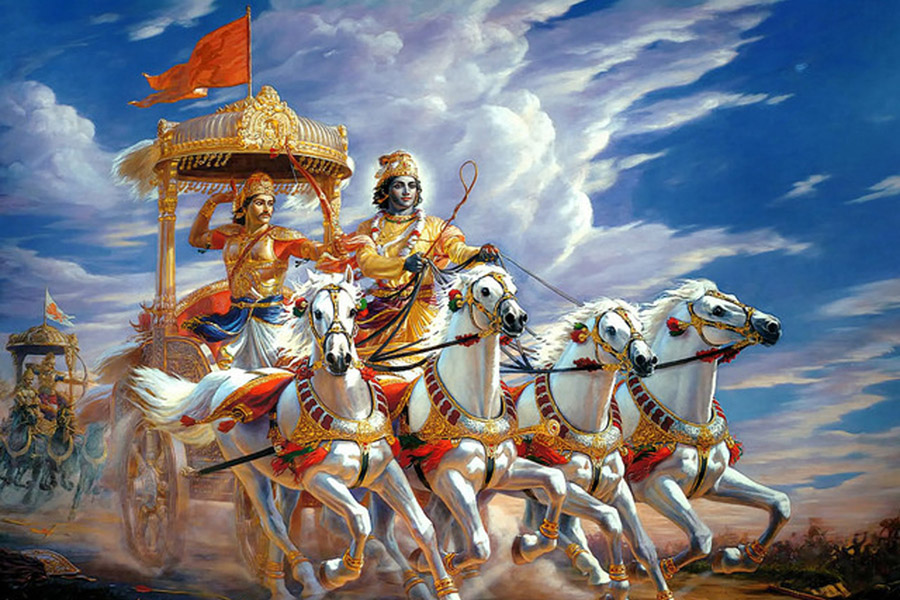
Consisting of 18 books, or parvas, this story revolves around the conflict between two factions of cousins, the Kauravas and Pandavas, for the throne of Hastinapura. It includes the famous Bhagavad Gita, a sacred Hindu scripture and a philosophical conversation between Prince Arjuna and Lord Krishna. The epic explores various themes such as duty, righteousness, family, war, and the nature of reality. It contains many notable characters: Krishna, Arjuna, Yudhishthira, Bhima, Nakula, Sahadeva, Draupadi, Duryodhana, and Karna. Known for its narrative, the moral, and philosophical dilemmas presented; it has a profound influence on Indian culture, literature, and religious beliefs.
The daughter of the river was named Girika and the king made her his wife. Once, the time for intercourse arrived and Vasu’s wife, Girika, having purified herself by bathing at the fertile time, informed her husband about her state. But on that very day, his ancestors came to him and asked the best of kings and wisest of men to kill some deer. Thinking that the command of his ancestors should be followed, he went out to hunt, thinking of Girika, who was exceedingly beautiful and like Shri herself. He was so excited that the semen was discharged in the beautiful forest and wishing to save it, the king of the earth collected it in the leaf of a tree. The lord thought that his semen should not be wasted in vain and that his wife’s fertile period should not pass barren. Then the king thought about this many times and the best of kings firmly decided that his semen would be productive, since the semen was issued when his queen’s time was right. Learned in the subtleties of dharma and artha, the king consecrated the semen, which was productive for producing progeny, and addressed a hawk that was seated nearby. ‘O amiable one! Please take this seed to my wife Girika. She is in her season now. The swift hawk took it from him and flew speedily through the sky.
The Adi Parva introduces the key characters and provides the background leading up to the great Kurukshetra War. It begins with the sage Vyasa narrating the story to the divine sage Narada. Vyasa, the author of the Mahabharata, is the son of the sage Parashara and Satyavati. He is requested by Brahma, the creator of the universe, to compose the epic to enlighten and guide humanity.